Why a Picky Eater Might Refuse a Food One Day and Love It the Next
Quick Answer: Food acceptance in picky eaters is influenced by factors beyond the food itself — hunger level, mood, sensory sensitivity that fluctuates day to day, and even subtle differences in how the same food was prepared — which is why a ‘safe’ food can suddenly get refused without any obvious explanation.
Yesterday they ate it without complaint. Today, the exact same food gets pushed away like it’s never been seen before. It’s genuinely frustrating, and it’s also a well-documented, common pattern in picky eating — not a sign you did something wrong.

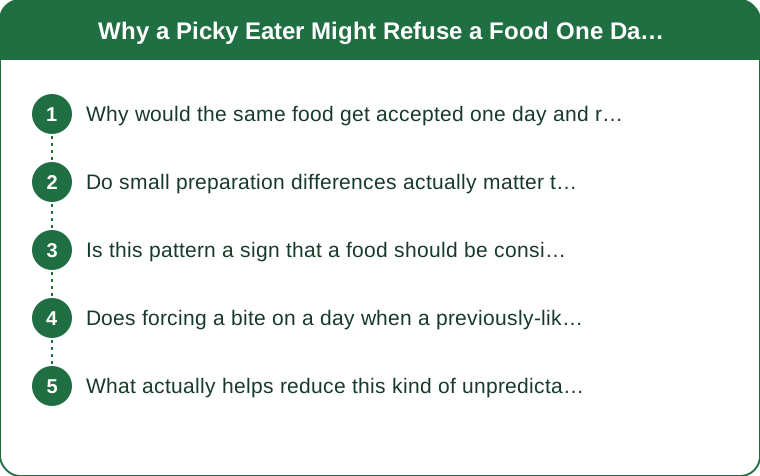
Why would the same food get accepted one day and refused the next?
Food acceptance isn’t purely about the food itself — it’s influenced by hunger level, mood, tiredness, and even sensory sensitivity that can fluctuate day to day for reasons that aren’t always visible from the outside. A child who’s slightly more tired or slightly less hungry than usual may have less tolerance for a food’s texture or smell that didn’t bother them the day before, even though nothing about the food changed.
Do small preparation differences actually matter this much?
Yes, more than most adults expect — a slightly different cooking time, a different brand, a different temperature when served, or even a different plate can register as a meaningfully different experience to a picky eater with heightened sensory sensitivity, even when the food is technically the same. Consistency in preparation, when possible, can reduce this specific source of inconsistent acceptance.

Is this pattern a sign that a food should be considered a failed food to stop offering?
Not necessarily — one refusal after previous acceptance doesn’t mean the food has been permanently rejected. Continuing to offer it in a low-pressure way (without treating the refusal as a final verdict) keeps the food in rotation for a day when conditions — hunger, mood, sensory state — line up more favorably again.
Does forcing a bite on a day when a previously-liked food is refused help or hurt?
It tends to hurt more than help — pressure around a refusal, even for a ‘safe’ food, can create a negative association that makes future acceptance less likely, compounding the original day-to-day inconsistency with an added layer of food-related stress.
What actually helps reduce this kind of unpredictability over time?
Keeping some elements consistent (same plate, similar preparation, familiar mealtime routine) reduces unnecessary variability, while accepting that some day-to-day inconsistency is a normal part of picky eating rather than something to fully eliminate. Patience with the pattern, rather than trying to solve it entirely, tends to serve families better long-term.
TL;DR:
- Hunger, mood, and fluctuating sensory sensitivity affect food acceptance day to day
- Small differences in preparation can register as meaningfully different to a sensitive eater
- One refusal doesn’t mean a food should be permanently dropped from rotation
- Forcing a bite on an off day tends to add stress rather than solve the inconsistency
This kind of day-to-day unpredictability is one of the most common and least talked-about parts of picky eating — it’s not a parenting failure, it’s just how sensory-driven food acceptance actually works.
Keep Reading
This article is for general informational purposes only and is not medical advice. Always consult a qualified health professional for guidance specific to you.