Why the 'Just Keep Offering It' Advice for Picky Eaters Often Backfires
Quick Answer: Repeated neutral exposure to a rejected food genuinely helps for many children, but when it’s paired with pressure to actually eat the food during each exposure, it often backfires by reinforcing the food as a stressful confrontation rather than a neutral, low-stakes object — separating exposure (seeing, touching, smelling, being near the food without pressure to eat) from the expectation of eating tends to work better than repeated offering that implicitly or explicitly comes with pressure.
“Just keep offering it” is technically correct advice that gets undermined constantly in practice, because most repeated offering comes bundled with subtle pressure that turns a helpful exposure strategy into a counterproductive one.

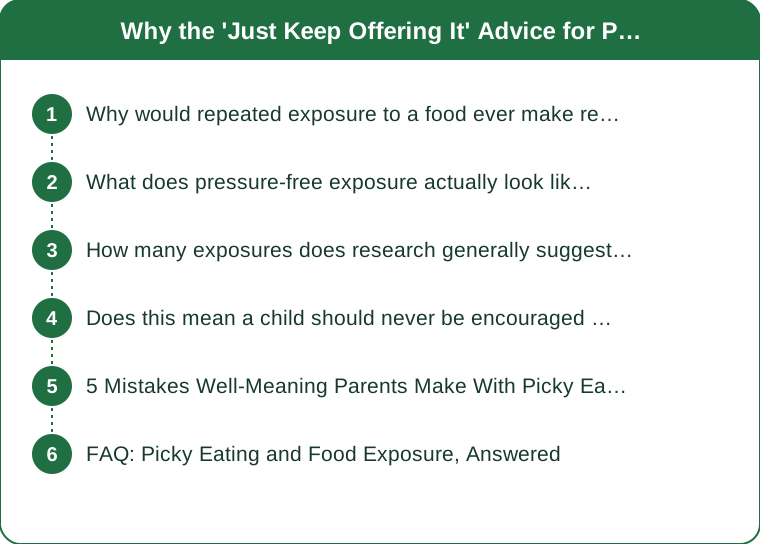
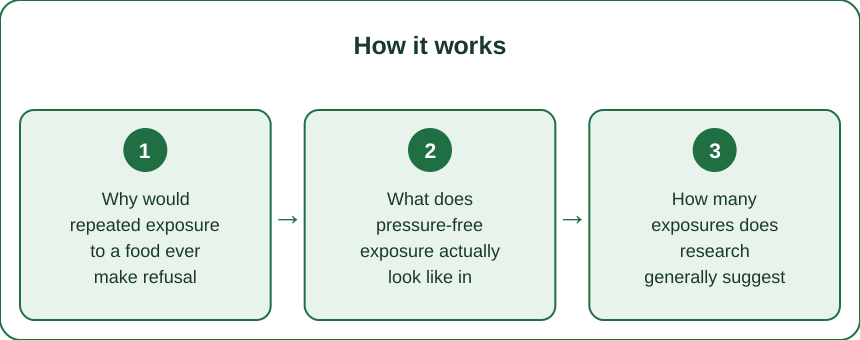
Why would repeated exposure to a food ever make refusal worse instead of better?
Research on food acceptance in children shows that repeated neutral exposure without pressure to eat does genuinely increase familiarity and eventual acceptance over many exposures, but when that exposure is paired with any pressure — watching expectantly, saying “just try one bite,” visible disappointment at refusal — the food becomes associated with a stressful social interaction rather than a neutral object, which can entrench refusal rather than reduce it over repeated instances of that same stressful pattern.
What does pressure-free exposure actually look like in practice, if it’s not about getting the child to eat the food?
Pressure-free exposure means the food is present on the table or the child’s plate without any expectation of eating it that meal — the child might look at it, smell it, touch it, or simply sit near it while eating other foods, with no comment, encouragement, or visible expectation from the adult about whether it gets eaten. This removes the stress component while still providing the repeated familiarity exposure that genuinely does build acceptance over time.
How many exposures does research generally suggest are needed before a rejected food is more likely to be accepted?
Commonly cited research suggests eight to fifteen or more neutral exposures are often needed before a new or previously rejected food is more likely to be accepted, which is meaningfully more than the handful of attempts many families try before concluding a food is a lost cause. This is part of why removing the pressure matters practically — a pressure-free approach is more sustainable to repeat that many times without the interaction becoming a recurring point of tension.

Does this mean a child should never be encouraged to actually try a food, ever?
Not necessarily — some families find occasional, low-pressure invitations (“you don’t have to eat it, but you’re welcome to try a tiny bit if you want”) work fine as long as they’re genuinely optional and infrequent, rather than a recurring expectation attached to every exposure. The key distinction is between an occasional, genuinely pressure-free invitation and a repeated pattern of expectation that turns each meal into a small negotiation.
5 Mistakes Well-Meaning Parents Make With Picky Eating
Commenting on whether the food got eaten — even positive comments (“good job trying it!”) reinforce that eating it was the expected outcome, adding pressure retroactively.
Only offering the food when it’s the main event — pairing a rejected food only with high-stakes family dinners adds pressure through context alone.
Removing the food after one visible reaction of disgust — this cuts the exposure short before any habituation can occur.
Bargaining or offering rewards for eating it — this reframes the food as an unpleasant obstacle to a reward, rather than a neutral food.
Giving up after only a handful of attempts — most food acceptance research points to needing far more repeated exposures than families typically try before stopping.
FAQ: Picky Eating and Food Exposure, Answered
Does this pressure-free approach work the same way for older children as for toddlers?
The underlying principle applies across ages, though older children may also benefit from being included in food preparation or choice, which can reduce the sense of a food being imposed on them.
Is it a problem if a food is offered pressure-free but genuinely never gets eaten after many exposures?
Not necessarily a failure — food preferences are influenced by many factors, and pressure-free exposure improves the odds of eventual acceptance without guaranteeing it for every specific food.
How should a parent respond in the moment if a child does try a pressure-free food and reacts negatively?
A calm, neutral response (“okay, that’s alright”) without over-comforting or over-praising keeps the interaction low-stakes, which supports the same pressure-free framework going forward.
TL;DR:
- Repeated neutral exposure genuinely builds food acceptance, but pressure during exposure often backfires
- Pressure-free exposure means the food is present without any comment or expectation about eating it
- Research suggests eight to fifteen or more exposures are often needed before acceptance becomes likely
- Commenting, bargaining, or stopping after a few tries are common ways well-meaning pressure creeps back in
The “just keep offering it” advice isn’t wrong — it’s incomplete, and separating exposure from the expectation of eating is the missing piece that makes it actually work over time.
Keep Reading
This article is for general informational purposes only and is not medical advice. Always consult a qualified health professional for guidance specific to you.