Why a New Food Gets Accepted on the Eighth Try and Not the Third
Quick Answer: Children typically need somewhere between 8 and 15 neutral exposures to a new food before accepting it, and the exposures have to be low-pressure to count. Most families stop after two or three because the early rejections look definitive. The mechanism is mere exposure — familiarity reduces the wariness response — and it only works when the food is offered without persuasion, reward, or negotiation attached.
The practical implication is that persistence with a specific presentation matters far more than variety of presentations, and that the pressure most people add is the thing preventing the process from working.
This is general information, not medical or nutritional advice for an individual child.

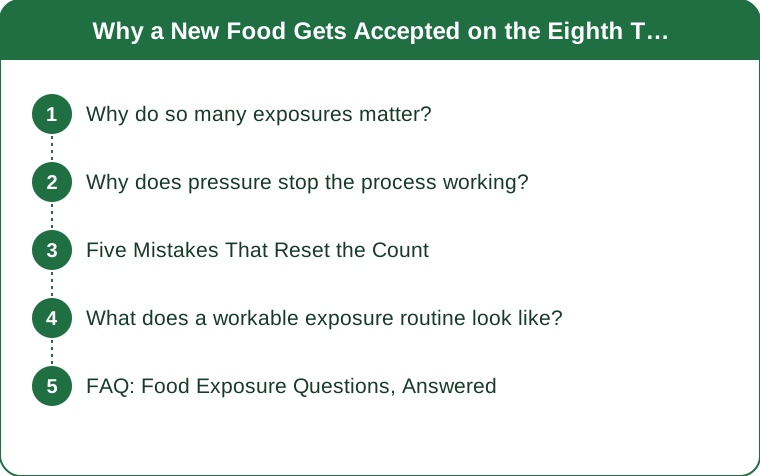
Why do so many exposures matter?
Because food wariness is a learned safety behavior, and unlearning it requires evidence.
Neophobia — wariness of new foods — is a normal developmental stage that peaks roughly between ages two and six. It is not a personality problem or a discipline problem. From a developmental perspective it is protective: a newly mobile child who ate everything unfamiliar would be at risk.
The way that wariness resolves is through repeated safe encounters. Seeing a food, smelling it, touching it, seeing others eat it, and eventually tasting it, all without anything bad happening, gradually reclassifies it from unknown to known.
The key detail is that this process is gradual and largely invisible. A child who has looked at a food seven times without touching it has made real progress that is not observable. Then on the eighth or twelfth encounter they pick it up, and it looks sudden.
This is why the standard parental experience is so discouraging. The first several exposures produce no visible response at all, which reads as failure. The progress is happening in a place you cannot see.
And it is why consistency of presentation helps. Broccoli steamed the same way six times is six exposures. Broccoli prepared six different ways is closer to six separate first exposures, because texture and appearance are a large part of what the child is learning.
Why does pressure stop the process working?
Because it changes what the child is learning.
When a food arrives with persuasion attached — one more bite, just try it, you liked it last time — the child is no longer having a neutral encounter with a food. They are having a social encounter about a food, and the thing being learned is that this item comes with pressure.
Pressure produces reliable short-term compliance and reliable long-term rejection. The research on this is consistent: children pressured to eat specific foods eat less of those foods over time, not more.
Rewards create a related problem. Offering dessert in exchange for eating vegetables teaches, quite logically, that vegetables are the cost and dessert is the value. You have used a strong signal to communicate that the target food is undesirable.
The alternative is genuinely doing nothing. The food is on the table or on the plate, it is available, and no comment is made about whether it is eaten. This feels passive and ineffective. It is neither — it is the specific condition under which exposure works.
The hardest part is that the parent has to be visibly indifferent, and children read this accurately. Watching expectantly is a form of pressure. Serving the food and turning your attention to your own meal is the practical version of the advice.

Five Mistakes That Reset the Count
Removing the food after two rejections. This is the most common one. Two exposures is roughly a fifth of the way to the typical acceptance point. Removing it there means the previous exposures are wasted.
Changing the preparation every time. Variety feels like giving the food a fair chance from multiple angles. In exposure terms it fragments the count across several different foods, since a child perceives roast carrot and raw carrot as genuinely different items.
Serving a large portion. A full serving of an unfamiliar food is visually overwhelming and increases the wariness response. A single small piece is a better exposure, because it is easy to look at and easy to ignore, and ignoring is a valid stage of the process.
Commenting on success. Praising a child for trying something is still attaching social significance to it. A neutral response — noticing without celebrating — keeps the encounter neutral, which is what makes the next one work.
Making a separate meal after a rejection. This is understandable and it teaches that rejection produces a preferred alternative, which removes any reason to engage with the exposure at all. Serving one meal that includes at least one accepted item solves this without a standoff.
What does a workable exposure routine look like?
Small, repetitive, and undramatic.
Pick one target food and stay with it for three weeks. Same preparation, offered two or three times a week. That is roughly eight to ten exposures, which is the range where acceptance commonly occurs.
Serve a small amount alongside at least one food the child reliably eats. The accepted food removes the pressure of the meal being a referendum on the new item, and it means the child eats regardless of the outcome.
Let them interact without eating. Touching, smelling, licking, and putting it back down are all genuine exposures and all count. A child who has handled a food is closer to eating it than one who has only seen it, even though neither has taken a bite.
Eat it yourself, visibly and without comment. Modeling is one of the stronger effects in this area. Eating the food with obvious ordinariness does more than any amount of encouragement.
Track it, quietly. Most families dramatically overestimate how many times they have offered something. A note on the phone with a tally often reveals that a food declared a definite no has been offered three times.
And know when this is not the right frame. Extreme food restriction, distress at mealtimes, gagging, weight concerns, or a very short list of accepted foods point toward something beyond typical picky eating, and are worth raising with a pediatrician or a feeding therapist rather than working through with exposure alone.
FAQ: Food Exposure Questions, Answered
Does the eight to fifteen range apply to older children too?
The principle holds, though the count varies more with age. Older children and adults also show mere-exposure effects, but explanation and involvement in cooking start to matter more than pure repetition.
Does it count if they only touch it?
Yes. Visual, tactile, and olfactory exposure all contribute. Requiring a taste for it to count is what makes the process feel impossible.
What if the same food is accepted at daycare but not at home?
Common, and it usually reflects the social environment rather than the food. Peer modeling is powerful, and home mealtimes often carry more accumulated history around specific foods. It is a good sign — it means the food itself is acceptable.
This is general information, not medical advice. Concerns about a child’s growth, nutrition, or eating behavior are worth discussing with a pediatrician.
TL;DR:
- Typical acceptance takes 8 to 15 neutral exposures; most families stop at two or three.
- Pressure and rewards reliably reduce long-term acceptance of the target food.
- Keep the preparation consistent for three weeks, serve a small amount beside an accepted food, and say nothing.
- Touching, smelling, and looking all count as exposures.
Pick one food and one preparation and tally the offers for three weeks. Most people discover they had been giving up around exposure three of a process that needed ten.
This is general information, not medical advice.
Keep Reading
This article is for general informational purposes only and is not medical advice. Always consult a qualified health professional for guidance specific to you.