Why 'Picky Eating' Might Be the Wrong Way to Think About Food Refusal
Quick Answer: Food refusal is often a sensory or trust response, not defiance — pressure-based approaches (bribing, forcing bites) tend to backfire, while low-pressure repeated exposure without a ‘must eat it’ expectation tends to build acceptance over time. This is general guidance, not a substitute for advice from a pediatrician or feeding specialist for significant feeding concerns.
‘Just picky’ frames food refusal as a preference to override with the right bribe or enough insistence. For a lot of kids (and adults), it’s closer to a sensory or trust response — and that reframe changes what actually helps.

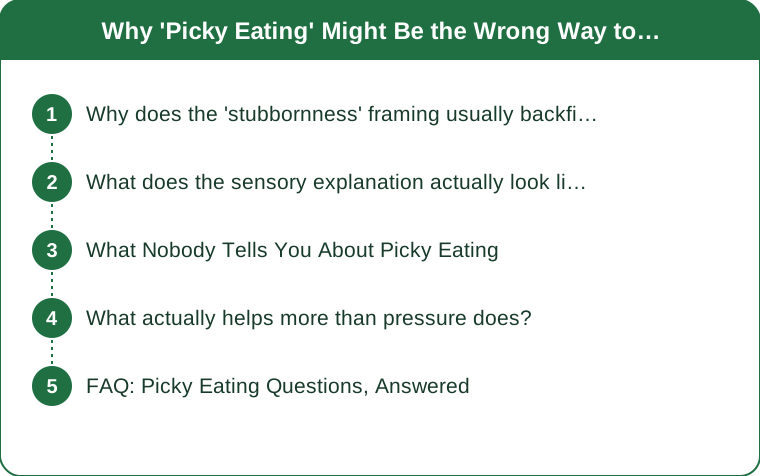
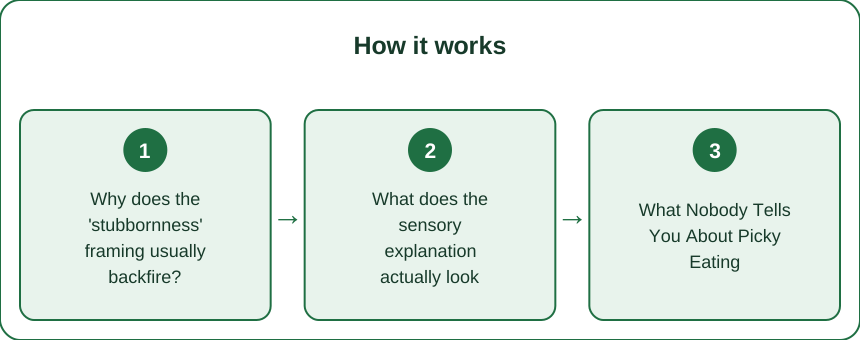
Why does the ‘stubbornness’ framing usually backfire?
Because pressure — bribing, forcing a bite, the clean-plate rule — treats refusal as a willpower problem, when for many picky eaters it’s a genuine sensory aversion (texture, smell, appearance) or a trust issue (uncertainty about an unfamiliar food). Pressure tends to increase anxiety around the food, which makes acceptance less likely over time, not more.
What does the sensory explanation actually look like in practice?
Some kids (and adults) have heightened sensitivity to texture, temperature, or smell — a food that seems ‘the same as last time’ to you can register as meaningfully different to them. This isn’t manipulation or being difficult on purpose; it’s a real difference in sensory processing that responds better to gradual, low-pressure exposure than to insistence.

What Nobody Tells You About Picky Eating
Research on feeding suggests it can take 8-15 exposures to a new food before a hesitant eater accepts it — and ‘exposure’ doesn’t have to mean eating it. Seeing it on the table, touching it, smelling it, or even just tolerating it being on their plate without pressure to eat all count as steps in that direction. Most households give up around exposure 2 or 3, well before the pattern has a chance to shift.
What actually helps more than pressure does?
Low-pressure repeated exposure: serve the food alongside safe, accepted foods without requiring it be eaten. Let them touch or interact with it on their own terms. Model eating it yourself without commentary on their choice. Remove the ‘must finish your plate’ expectation entirely — the goal is reducing food-related anxiety, which is what actually opens the door to trying something new.
FAQ: Picky Eating Questions, Answered
Should I hide vegetables in food instead of dealing with the refusal directly?
Hiding can work for nutrition in the short term but doesn’t build acceptance of the actual food — a mix of both approaches tends to work better than relying on hiding alone.
When does picky eating become a concern worth addressing with a professional?
If a child’s diet is extremely limited (fewer than 20 accepted foods), involves significant weight or growth concerns, or causes major mealtime distress, a pediatrician or feeding specialist can help — this article is general guidance, not a diagnosis.
Does picky eating usually improve with age?
For many children, food acceptance broadens gradually through the school-age years with continued low-pressure exposure — though the timeline varies a lot child to child.
TL;DR:
- Food refusal is often sensory or trust-based, not stubbornness or defiance
- Pressure tends to increase anxiety around food, reducing acceptance over time
- It can take 8-15 exposures before a food is accepted — most households stop at 2-3
- Low-pressure repeated exposure beats bribing or forcing bites
This is general guidance — significant feeding concerns deserve input from a pediatrician or feeding specialist.
Keep Reading
This article is for general informational purposes only and is not medical advice. Always consult a qualified health professional for guidance specific to you.