Why a Picky Eater Will Happily Eat a Vegetable Raw But Refuse the Exact Same One Cooked
Quick Answer: Raw and cooked versions of the same food have meaningfully different textures, temperatures, and sometimes flavors due to the cooking process breaking down cell structure and releasing different compounds — for a texture-sensitive picky eater, this can make the two versions feel like genuinely different foods, not just two forms of the same one.
Parents often assume a raw-only preference is stubbornness, but it’s usually a straightforward sensory response to real textural and flavor differences that cooking creates.
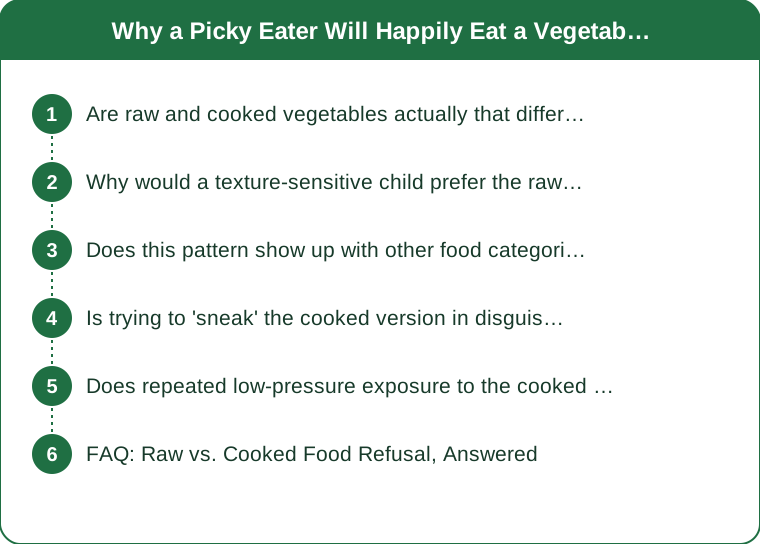
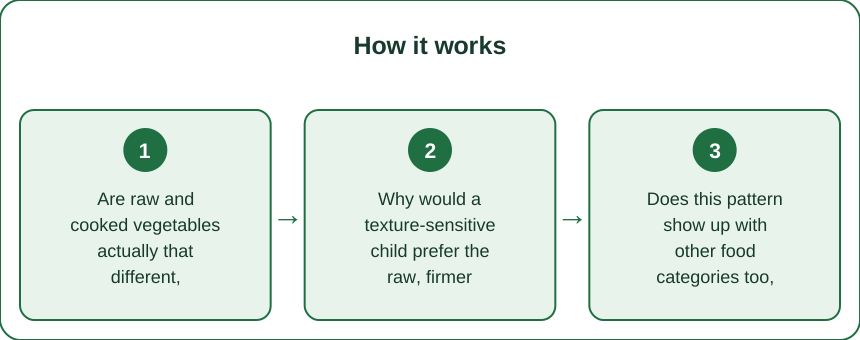
Are raw and cooked vegetables actually that different, sensory-wise?
Yes, substantially — cooking breaks down plant cell walls, releasing different compounds and changing texture from firm and crisp to soft and often more uniform, which also changes flavor intensity (cooking can concentrate or mute different flavor compounds depending on the vegetable). For a child with heightened texture sensitivity, this isn’t a minor variation — it can register as an essentially different food.
Why would a texture-sensitive child prefer the raw, firmer version specifically?
Firm, crisp textures provide more distinct, predictable sensory feedback (a clear crunch, defined edges) than soft, cooked textures, which can feel mushy, inconsistent, or harder to predict in the mouth — many texture-sensitive eaters, picky or with broader sensory processing differences, gravitate toward foods with more textural predictability, and raw vegetables often fit that category better than cooked ones.
Does this pattern show up with other food categories too, not just vegetables?
Commonly, yes — the same raw-versus-cooked or firm-versus-soft preference pattern shows up with fruits (raw apple versus cooked applesauce), proteins (crispy versus soft-cooked textures), and grains, suggesting the underlying driver is genuinely about texture predictability rather than something specific to vegetables alone.
Is trying to ‘sneak’ the cooked version in disguised form a good strategy here?
Generally not recommended by feeding specialists — disguising a refused texture (blending it into a sauce, hiding it in another food) doesn’t address the underlying texture preference and can undermine trust if discovered, which may make future food acceptance harder. Offering the accepted raw version consistently while separately, non-pressuringly exposing the cooked version tends to be the more sustainable approach.
Does repeated low-pressure exposure to the cooked version eventually work?
Often, yes, though it can take many exposures — feeding research generally suggests it can take upwards of 10-15 low-pressure exposures to a refused food or texture before acceptance develops, if it develops at all. The key elements are that exposure needs to be genuinely low-pressure (no requirement to eat it) and repeated, not a single attempt.
FAQ: Raw vs. Cooked Food Refusal, Answered
Is it fine nutritionally to just let a child eat the vegetable raw long-term if that’s all they’ll accept?
Raw vegetables generally offer comparable or sometimes even higher levels of certain nutrients than cooked versions, so a raw-only preference isn’t nutritionally concerning on its own for most vegetables.
Does this texture sensitivity pattern usually fade with age?
Many children’s texture preferences do broaden over time with continued low-pressure exposure, though the timeline varies widely by child.
Should you keep offering the cooked version even if it’s consistently refused?
Many feeding specialists recommend continuing to offer it in a low-pressure way (on the plate, no pressure to eat) since repeated exposure without pressure is the most consistently supported path to eventual acceptance.
TL;DR:
- Cooking meaningfully changes a food’s texture, temperature, and flavor compounds, not just its form
- Texture-sensitive eaters often prefer the more predictable crunch of raw over soft cooked textures
- This raw-versus-cooked pattern commonly extends beyond vegetables to fruits, proteins, and grains
- Disguising the refused texture is less effective long-term than low-pressure repeated exposure
It’s not stubbornness — raw and cooked genuinely register as different foods to a texture-sensitive eater, and treating them that way (rather than assuming refusal is arbitrary) makes more progress.
Keep Reading
This article is for general informational purposes only and is not medical advice. Always consult a qualified health professional for guidance specific to you.